
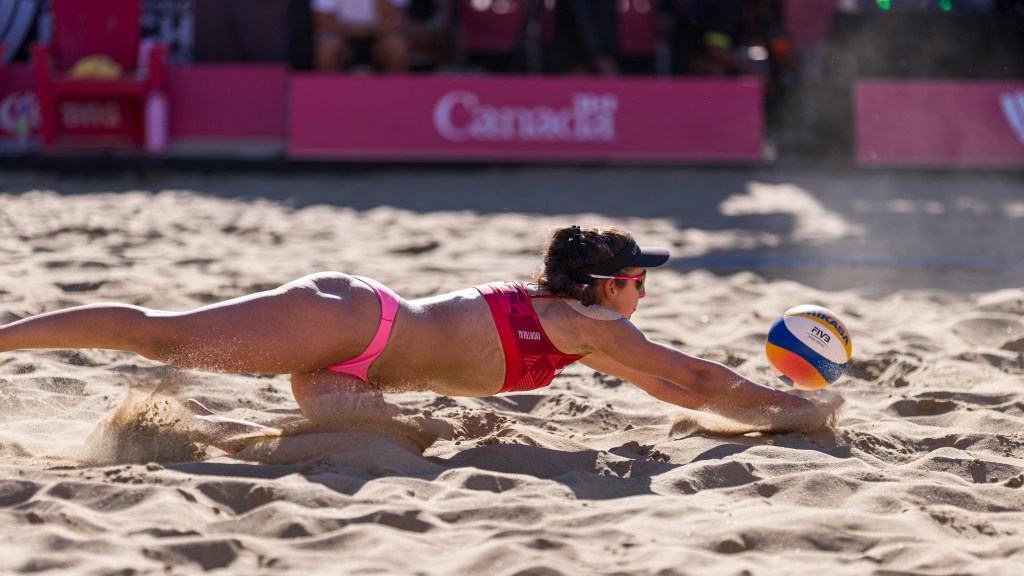
50 flights. 11 countries. 190,891 kilometres. It’s enough to make your head spin. That was Melissa Humana-Paredes’ travel in 2025 as a professional beach volleyball player. Behind every sporting event and athletic performance lies a hidden cost: travel-related emissions. Last year, Melissa spoke to Sport+Eco about how climate change is already affecting her sport, from extreme heat and wildfire smoke to changing competition schedules. She also pointed to athlete travel as one of the biggest contributors to her personal environmental footprint. This year, she is measuring and tracking her travel. Let’s see how she leverages her athletic achievements to support climate action.
While Melissa is back in Montréal for the 2026 Beach Pro Tour Elite16, which ran from August 19–23, she is using her platform to question one of the less visible environmental costs of professional sport: the kilometres athletes have to travel to compete. The Montréal competition is the highest level of the Beach Pro Tour, with the world’s top 16 teams per gender, and Volleyball World describes the tour as visiting nearly 40 countries annually. This year, Montréal was the only stop in North America. This may reduce their footprint.
“Dig for the Planet”: Melissa Humana-Paredes turns her volleyball performance into climate action
Melissa Humana-Paredes has found a way to connect two things that define her role as an athlete and Olympian (x2): the dig and the desire to protect the future of sport.
The Canadian beach volleyball player and Olympian Melissa Humana-Paredes launched a campaign to fight climate change called “Dig for the Planet”, in collaboration with Partnered High Impact Athletes and their Sport One Carbon Zero initiative.
She shows that athlete voices can make a big difference by using their own sports moves to bring awareness to climate change. As a very good defensive player, she does many “digs” to save the ball from her opponent’s attacks. So during beach volleyball competitions, she makes donations with her personal money for every single defensive dig she makes.
She started donating 10$ per each defensive dig in 2025 during the Australian World Championships, where she did 84 digs and donated 840$ for the planet (second-highest digger of the tournament). During this campaign, her sponsors Lululemon and Left on Friday matched her donation in addition to many other private donors, for a total of 4184 $.
Every dollar goes to Sport One Carbon Zero, an athletes-led movement tackling sports’ biggest emissions (travel, energy and infrastructure)
In 2026, the amount has increased to $20 per “dig”, Melissa is inviting fans to match her pledge or contribute whatever they can. She told The Canadian Press that she hopes the campaign can reach $10,000.
According to her, this donation and program is 10 times more effective than carbon offsets. – Here is the fund: Melissa One, Carbon Zero — High Impact Athletes.

Why ? The hidden travel footprint of professional sport
As a professional athlete and climate advocate, she started to track all her flights to go to her competitions all around the globe. In 2025, she tracked her travel and recorded 50 flights across 11 countries, covering 190,891 kilometres. These numbers are enormous. As she explained in one of her video on Instagram “I’m not promoting this lifestyle or encouraging this amount of travel. In fact, I’m trying to do the opposite. I’m sharing these out-of-range numbers to be transparent about how much athletes travel and how much of a toll it takes mentally, physically, emotionally…”.
Beyond affecting athletes’ performances, it also creates a lot of carbon footprint.
She has been offsetting her travelling since 2025 and wanted to find a better way to donate this money. (about 1513$ carbon offset compensation, according to a math done by Racong To Zero).
She is making a totally new approach from offsetting her carbon footprint to tracking and understanding the real impact of her travels.
Her travel tracking adds another dimension to that argument: before asking athletes to change their behaviour, perhaps sport also needs to examine the system that determines how much travelling is required in the first place. The athlete is not necessarily choosing 50 flights. The competition system is creating the need for them. This is why athletes’ voices are crucial. Humana-Paredes is not alone in trying to quantify the environmental impact of an athlete’s career. Canadian freestyle skier Marion Thénault has also worked on measuring her carbon footprint, including through work with WSP. Marion Thénault – La première olympienne carboneutre du Canada – Sport+Eco
Conclusion
Behind the idea of “Dig for the Planet” as a tool or model that other athletes and teams could adopt. What if athletes in every sport could turn a part of their performance into climate action?
It is truly inspiring to see how a Canadian athlete-led climate initiative turns their performances and their sports into funding for climate solutions.


Publié par



Laisser un commentaire