
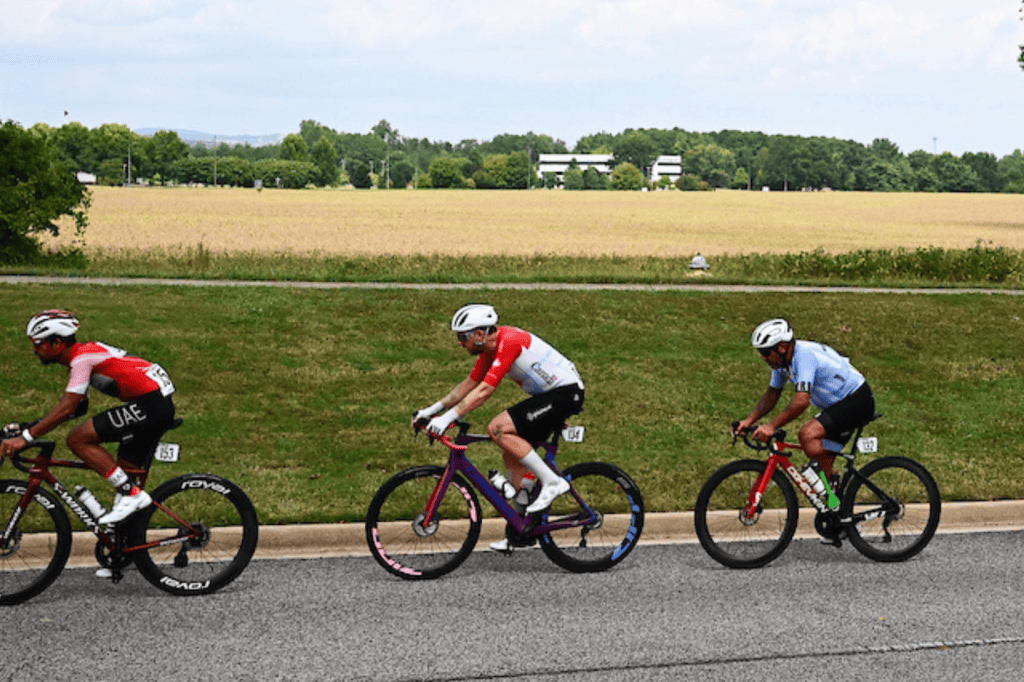
Cycling Canada wanted to take action on sustainability. The challenge was familiar to many sports organizations: limited resources, limited capacity and no clear starting point. Let’s see how a sports federation with limited resources moved from intention to a structured sustainability development strategy. This is why they took part in the Canadian Olympic Committee pilot sustainability program. Through this program, they took the opportunity to measure and understand their data and where its impact came from, to finally start identifying concrete areas for action. What did Cycling Canada learn by measuring its carbon footprint?
Josh Peacock, Director of Business Development & Communications at Cycling Canada, spoke with Sport+Eco about the NSO’s journey to finally set their sustainability strategy, what they learned from measuring their footprint and gathering data.
« You can’t reduce what you don’t understand.” – Josh Peacock
Sport+Eco is launching a series of articles on cycling.
Cycling is often seen as a form of active and sustainable mobility, and therefore as one of the most environmentally friendly ways to get around. But that doesn’t mean professional cycling is automatically sustainable.
Through this series, we’ll explore how national federations and event organizers are taking action to build a more resilient sport.
4 weeks. 4 questions about the future of cycling.

Sport+Eco : “Why did it take that long?”
Josh Peacock: “I think probably a lot of us have a similar challenge when it comes to resources. We all wanted to do something. We wanted to make a change. The first thing was getting the resources that we needed to make it happen. That’s really where it all started.
There are always people like me and some of my other colleagues that are very passionate about environmental sustainability. I would say, probably, most of our staff believe in this and they have a real passion for it.
Sport has the ability to influence our athletes, our teams, and people who are watching us all the time. We were lucky enough to be one of the first three National Sports Organizations (NSO) that got selected for the COC program. And that filled the gap for the resources that we needed to make it happen.”
This message many NSOs can relate to. They are all facing the same climate change and they want to do better to reduce their footprint, as we saw with Steve Wallace from Canada Artistic Swimming. They don’t act because they don’t care. They don’t act as they should or would because they don’t have the internal capacity.
Sport+Eco : What finally allowed Cycling Canada to move forward?
You can’t reduce what you don’t understand. This is why Cycling Canada took part in the pilot program launched by the Canadian Olympic Committee in 2025, to support NSOs.
This project was launched by the COC with the support of the International Olympic Committee (IOC). Three national sport federations Artistic Swimming Canada, Cycling Canada, and Freestyle Canada benefited from the expertise and support of Racing to Zero to help them develop their sustainability strategies and establish their baseline emissions.
To learn more about this program, read this article : https://sportpluseco.com/2025/07/21/au-dela-des-podiums-et-des-records-le-coc-sengage-pour-la-planete/
Josh Peacock: Also the Fédération Québécoise des Sports de Cyclisme had developed, prior to any of this, their own sustainability strategy, and so had the UCI, our international partner. So, really, we had these great resources around us to develop this amazing certification for events that we will very likely take nationally and apply nationally to some of our events.
That’s part of our sustainability strategy in the coming years is to roll that out over time. So, we were inspired by our provincial, our PSO partner in Quebec, who did an amazing job. »
In April 2026, Cycling Canada released its Environmental Sustainability Strategy, turning the work initiated through the pilot into a longer-term framework for the organization. – ENVIRONMENTAL SUSTAINABILITY STRATEGY | Cycling Canada
Sport+Eco: “Why do you think it’s important to know your carbon footprint?”
Josh Peacock: « I think it’s important to know, just like it’s hard to go in and seek support. If we want to offset, for example, and we want external support to help us with that, I think there are two parts. One is, how do you sell sponsorship for carbon offsetting if you don’t actually know? Or how do you seek grants? We wanted to have a base-level understanding of this, and this was just in the events side of things and just for our national championships. But if that gave us a snapshot of what type of carbon emissions our events were responsible for, which made it easier then to go and start looking at prospective sponsors or prospective grants that we could bring in to help support the offsetting.”
Rather than seeking offsetting as our primary solution, what can we do to change the behavior of people at events? You know, how they travel to events or, you know, what they do when they’re there to act more sustainably. So, I think for us, before you seek external support, before you’re looking for extra funding or grants, you need to have a base-level understanding of where you are at.
We started with something simple and low-administration. We added a few questions to our online registration for national championships about travel and accommodation. It gave us simple data that was easy to analyze and helped support the sustainability pilot project.”
Cycling Canada’s work eventually helped establish a 2025 carbon footprint of 1,700 tonnes of CO₂e, providing a baseline for its sustainability strategy.
Sport+Eco: What would you recommend to NSO or any organization that is starting its sustainability journey?
Josh Peacock: « We didn’t have resources, we didn’t have a ton of knowledge. But I’d say, like, the first step is to start gathering data where it’s easy to gather data, where it feels natural to people. So, we started collecting carbon footprint data or carbon emissions data from event participants.
Just gather the data, put it off to the side until you can work with a consultant or whatever that may be. You can just gather data, understand your carbon emissions as an organization, put a few questions into an online registration process, for example, or an annual survey, or whatever it might be.
We started by adding a few questions to our online registration process how far people travelled, how many nights they stayed and what form of transportation they used. It didn’t require hours of staff work, and we never received a single complaint. Even if you don’t have the capacity to analyze the data yet, just start collecting it. We’ve never received a single complaint.
And we had this amazing data available to us. It’s not as hard as you think. And there are many consultancies or professionals who will help you, help guide you on what type of data to collect. Like, you want to make sure it’s the right kind of data.
I would also recommend looking to your national and international sport partners. The COC sustainability program provided us with expertise and support that we didn’t have internally, while international federations often have resources available to their partners. »
Conclusion
Cycling Canada is the perfect benchmark of how a sports federation with limited resources moved from intention to a structured sustainability development strategy. Even if you have a lack of resources, you can still gather as much data as possible. The support of the Canadian Olympic Committee will have a huge impact on the future of sports in Canada. The pilot was not the end of the journey. It was the starting point.
As we are about to witness the busiest month of cycling in Montréal, with the UCI Road Cycling Championships, we thought that we should learn more about the sustainability strategy taken by the organising committee that organizes major events in Canada. In the next articles, we will focus on the Grand Prix Cycliste de Québec et Montréal, then the world championships.
But measuring and reducing emissions is only part of the challenge. For Canadian sport, another question is becoming increasingly urgent: how do we adapt to the climate we’re already experiencing?



Publié par

 Sport+Eco
Laisser un commentaire